




Dry sandpaper: A master in the industrial grinding field
May 13, 2025
Leave a message
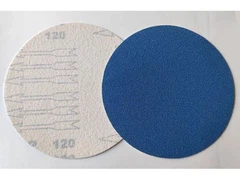
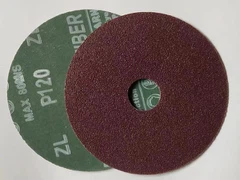
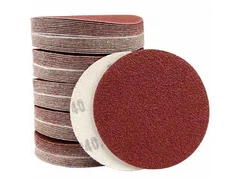
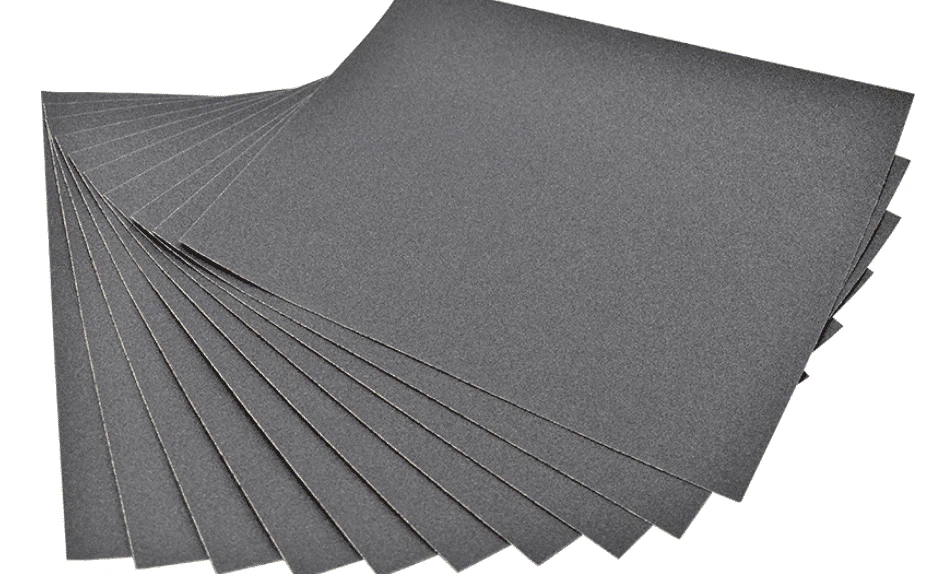
Dry abrasive paper is a type of water-resistant sandpaper with silicon carbide or aluminum oxide as the abrasive and latex paper as the backing, specifically designed for dry grinding processes. It features strong wear resistance and excellent clog resistance, making it suitable for surface grinding of materials such as metal, wood, and plastic. It can efficiently remove burrs, oxide layers, or old paint films. Widely used in DIY, auto repair, furniture manufacturing, and other fields, it is an ideal choice for manual or power tool grinding, significantly enhancing surface smoothness and flatness, and laying a high-quality foundation for subsequent coating or treatment.
I. Historical Tracing: The Evolution from Natural Materials to Modern Technology
The history of sandpaper as a grinding tool can be traced back to ancient times when humans used natural materials such as horsetail grass and brick powder for surface treatment. After the Industrial Revolution, the demand for standardized grinding tools emerged with the advent of mechanized production. In 1921, 3M Company in the United States invented the first dry and wet sandpaper, marking the birth of modern sandpaper technology. This product utilized a waterproof backing and resin adhesive, solving the problems of traditional sandpaper being prone to damage and having poor water resistance. It was initially used for polishing car paint surfaces and gradually expanded to fields such as metal processing and wood treatment.
The independent development of dry sandpaper is closely related to its application scenarios. In the mid-20th century, with the rise of the furniture manufacturing and building decoration industries, the demand for efficient dry grinding tools soared. Traditional wet grinding methods required frequent water changes and were less efficient, while dry sandpaper quickly gained market share due to its characteristics of being ready-to-use and having controllable dust. Since China's reform and opening up, the sandpaper industry has developed rapidly. By introducing electrostatic planting technology, the uniformity of abrasive distribution has been improved and the product life has been extended.
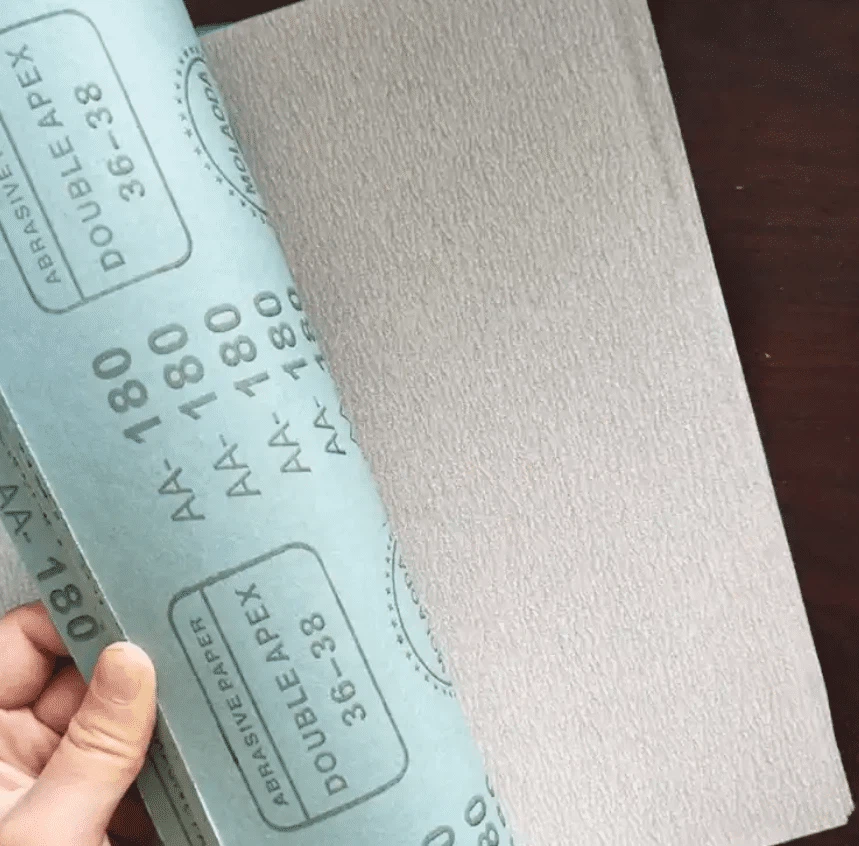
II. Materials Science: Precise Matching of Base Materials and Abrasives
The core structure of dry sandpaper is composed of base material, abrasive, and adhesive. The choice of base material directly affects the flexibility and durability of the sandpaper: specially treated kraft paper has strong tear resistance and is suitable for rough grinding; latex paper, with its smooth surface, is more suitable for fine-grit sandpaper. In terms of abrasives, silicon carbide, due to its high hardness and self-sharpening property, has become the mainstream, with a particle size range from 40 mesh to 2000 mesh covering all process requirements. Although aluminum oxide has slightly lower hardness, its cost advantage enables it to hold a position in the mid-to-low-end market.
Bonding technology is the key to performance. Synthetic resins form a three-dimensional network structure through high-temperature curing, firmly anchoring the abrasive. The application of anti-static coatings solves the clogging problem caused by dust adhesion during dry grinding, allowing the sandpaper to maintain its cutting force when grinding materials such as metals and putties that easily produce fine debris. Some high-end products use composite bonding agents to strike a balance between heat resistance and water resistance, adapting to complex working conditions.

III. Manufacturing Process: The Precise Flow from Raw Fabric to Finished Product
The production of dry sandpaper involves three core processes:
Base material treatment: Paper substrates need to be impregnated and scraped to enhance strength, while fabric substrates undergo singeing and calendering to remove surface fuzz, ensuring uniform sand coating.
Electrostatic sanding: Compared with traditional gravity sanding, the electrostatic field enables abrasive particles to be arranged in a single layer in an orderly manner, with the sharp ends facing outward, improving cutting efficiency. This process is particularly effective for abrasive particles under 500 nanometers, while coarse-grained products still require mixed use.
Curing and post-treatment: High-temperature curing ensures that the resin fully encapsulates the abrasive particles. Subsequent humidification and flexing processes eliminate internal stress, preventing the sandpaper from curling or deforming during use.
Quality control throughout the entire process: A laser detection system continuously monitors the substrate thickness, and computer-controlled adhesive application ensures that the distribution error of abrasive particles per square meter is less than 2%.

IV. Performance Characteristics: The Art of Balancing Efficiency and Durability
The performance advantages of dry sandpaper are reflected in:
Anti-clogging design: The gap between the abrasive grains is over 30% larger than that of water sandpaper, allowing grinding debris to fall off automatically and extending continuous working time.
Anti-static feature: The conductive coating prevents dust from adhering, improving vision clarity and reducing operational fatigue.
Balance of flexibility and rigidity: The latex paper substrate is less prone to breakage when bent, making it suitable for grinding irregularly shaped parts.
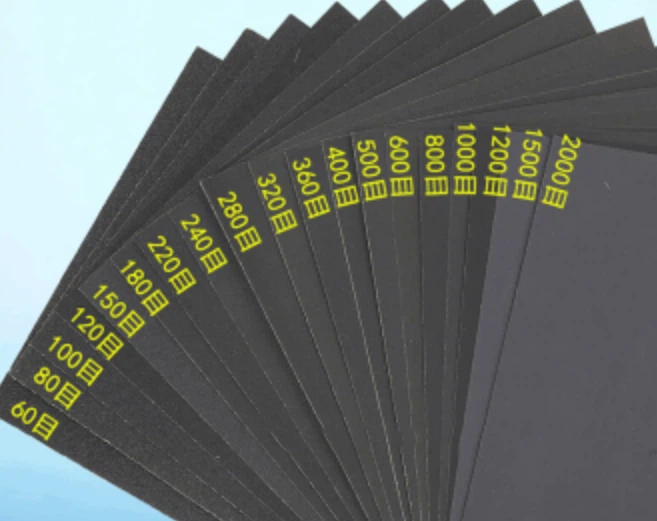
In practical applications, 80-120 mesh sandpaper is used to remove weld seams and old paint layers; 180-240 mesh is suitable for grinding furniture primer; and products with 400 mesh or higher are used for fine polishing. Test data shows that high-quality dry grinding sandpaper can increase efficiency by 40% when grinding steel plates of the same area compared to water sandpaper, and reduce abrasive consumption by 25%.
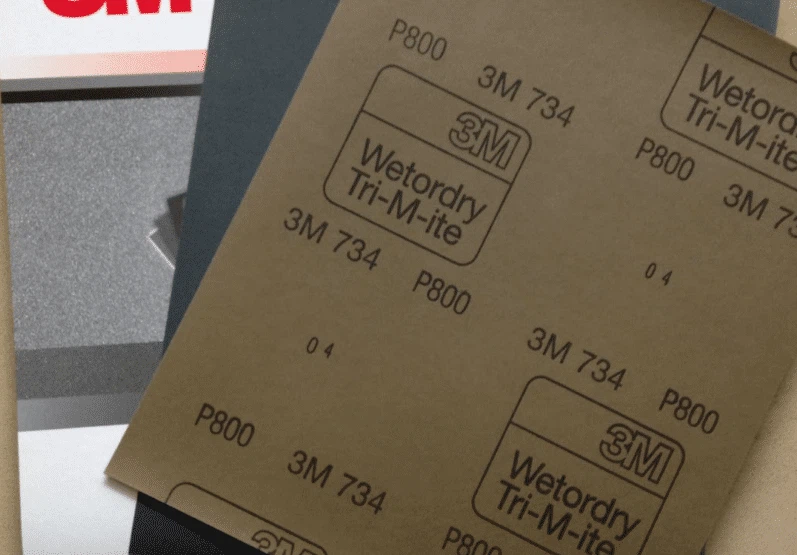
V. The Use of Art: Synergy of Techniques and Tools
Professional craftsmen have developed a variety of efficiency-enhancing techniques:
Tool adaptation: Low-grit sandpaper should be fixed to an angle grinder with a sandpaper holder, while high-grit products should be used with a pneumatic sander to avoid uneven pressure and resulting scratches when done by hand.
Dust management: A sandpaper disc connected to an industrial vacuum cleaner can reduce airborne particles and meet OSHA standards.
Special shape processing: Cut the sandpaper into strips and wrap them around a hot melt adhesive tube to grind circular holes; attach it to an arc-shaped rubber block for polishing car wheels.
Recycling: The worn side of the sandpaper can be coated with glue and used as a backing pad for the sandpaper holder, or cut into small pieces for grinding narrow gaps.
VI. Industry Terminology and Interesting Facts
Mesh Paradox: 800-grit sandpaper is not finer than 600-grit; rather, the number of sieve holes per square inch increases from 600 to 800, resulting in a reduction in actual particle size.
Directionality of Sandpaper: The cross-grain sanding method (first longitudinally then laterally) can eliminate unidirectional scratches, but attention should be paid to the wood grain direction.
Extreme Applications: In spacecraft manufacturing, 3000-grit dry sandpaper is used for surface pre-treatment of titanium alloys to ensure coating adhesion.
Send Inquiry