


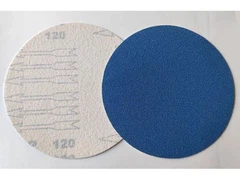
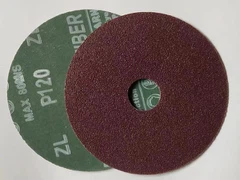
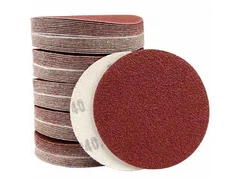


Do you really understand the different types of sandpaper?
Dec 17, 2025
Leave a message
The classification of sandpaper requires a comprehensive consideration of three dimensions: abrasive material, backing material structure, and application scenario. These three factors collectively determine the sandpaper's cutting ability, heat dissipation performance, and applicable range.
1. Abrasive Material: Chemical properties determine cutting efficiency.
• Silicon Carbide Sandpaper: The black abrasive has a triangular pyramid structure and excellent self-sharpening properties, maintaining a sharp edge throughout the grinding process. Its high thermal conductivity makes it ideal for non-ferrous metals such as aluminum alloys and ceramics, especially suitable for wet grinding processes. For example, in the processing of aerospace aluminum alloy components, silicon carbide sandpaper combined with wet grinding can stably control the surface roughness below Ra0.8um.
• Aluminum Oxide Sandpaper: The red abrasive is known for its high toughness and fracture resistance, suitable for rough and fine grinding of hard metals such as steel and stainless steel. In automotive sheet metal repair, P180-P400 grit aluminum oxide sandpaper can achieve gradient processing from removing old paint layers to surface smoothing.
• Diamond Sandpaper: As a representative of superhard abrasives, its microscopic cutting edge density can reach hundreds of millions per square centimeter. In the field of optical mirror polishing, it can reduce surface roughness to the Ra0.01um level, but the cost is 3-5 times higher than traditional sandpaper.
• Garnet Sandpaper: This natural mineral abrasive has gentle cutting characteristics and is often used for fine sanding of soft woods such as pine and cedar, preventing fiber tearing caused by excessive cutting.
2. Substrate Structure: Physical Properties Affect Processing Stability
• Paper Substrate: Uses high-strength latex paper or kraft paper, which is low in cost but has limited tear resistance. 3M's developed electrostatic abrasive coating process improves abrasive distribution uniformity by 40%, significantly improving processing consistency.
• Cloth Substrate: Polyester fiber cloth substrate has excellent tensile strength and can withstand the centrifugal force generated by high-speed rotation in robotic automated grinding. Bosch E466 series sanding discs with a velvet backing achieve efficient dust removal through an 8-hole design, extending their service life by 2-3 times compared to paper sandpaper.
• Sponge Substrate: Polyurethane sponge carrier gives the sandpaper good flexibility, achieving over 98% conformity in curved surface processing. The Kraftwell YS3239 sponge sandpaper set, with its graded grit design (400-2000 grit), allows for a mirror-like finish on solid wood furniture surfaces.
3. Application Scenarios: Process Requirements Drive Product Innovation
• Dry Sandpaper: Synthetic resin binders provide excellent anti-clogging properties, allowing for continuous operation for more than 2 hours during the rough grinding of metals without replacement. Japanese Riken dry sandpaper utilizes nano-level anti-static coating technology to reduce dust adsorption rate to below 5%.
• Wet Sandpaper: The combination of varnish binder and silicon carbide abrasive gives it water-resistant properties. In automotive paint repair, when used with a water circulation system, the processing temperature can be controlled within 40℃, effectively preventing thermal deformation. 3M 401Q wet sandpaper uses a microporous structure design to increase coolant penetration by 60%.
• Sponge Sandpaper: Its three-dimensional structure gives it a unique advantage in processing irregularly shaped parts. German Hermes sponge sanding blocks, through density gradient control technology, achieve a seamless transition from rough grinding to fine grinding. In the processing of titanium alloy components for medical devices, it can control the surface roughness uniformity within ±0.2um.
Send Inquiry